If you possess even a single working ear, you’ve probably heard me mention that I take a certain pleasure in avoiding bestseller lists. I’m very much a “thrill-of-the-hunt” type of reader – I like the flirtation of wandering into a bookshop and letting the right one find me. There’s a certain thrill in stumbling across a hidden gem all on your own. But recently, I’ve noticed a rather troubling pattern: I own very few books that don’t start with a fantasy map and a pronunciation guide. Clearly, a girl’s gotta branch out.
Therefore, in attempt to broaden my literary horizons, I’ve returned to the aforementioned bestseller lists in search of new material – and have discovered, in a shocking twist nobody saw coming, that some of the recommendations are, admittedly, really rather good.
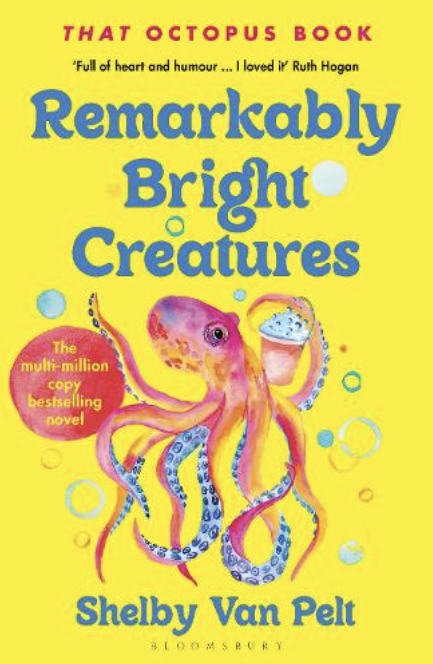
Remarkably Bright Creatures is one such book. It had hovered at the edges of my awareness for some time before I bought it for the octopus on the front cover – only to promptly banish it to the shelf once I realised it involved a woman befriending an intelligent sea creature. Not quite for me, thanks – I’ve seen The Shape of Water. But a debut novel on the NYT bestseller list, winning the 2023 First Novel Prize, AND being nominated for Audiobook of the Year? There’s only so many signs the universe can send.
“Humans…For the most part you are dull and blundering. But occasionally you can be remarkably bright creatures.”
At the heart of the novel is Tova Sullivan, a 70-year-old widow whose life has been defined by loss: her son Erik, decades ago, and the more recent deaths of her husband and estranged brother. Her tidy, minutely-controlled life is barely held together by the small, rigid routines that make her existence bearable – or at least keep her so busy, she barely has time to fall apart.
“She understands what it means to never be able to stop moving, lest you find yourself unable to breathe.”
Tova works at Sowell Bay Aquarium, where she meets Marcellus, a giant Pacific octopus who has spent nearly his entire life in captivity. At four years old, he’s as elderly as Tova is at seventy, and is as sharp-witted, observant, and unflinchingly honest as she. They are, on the surface, an unlikely pair: an elderly woman trying to mend the edges of her lonely life and an octopus nearing the end of his brief, but brilliant existence. Yet the two of them are bound by what they have lost. Tova has never stopped mourning her family, and Marcellus grieves for the freedom that was stolen from him, and the idea that he will die in the same tank he has spent his life in. Both of them rely on private rituals to fill the space in their empty days: Tova careful maintains the aquarium near the beach where her son used to work, and Marcellus frequently escapes his tank to steal snacks and source trinkets for his collection.
“To the extent happiness is possible for a creature like me, it lies in knowledge.”
A striking triumph of this novel is the extraordinary intimacy between Van Pelt’s narrative structure and the tale that unfolds. In my experience, multi-perspective stories can be double-edged swords. Done poorly, they can muddy the narrative; when executed well (think George R.R. Martin’s Game of Thrones or Natalie Haynes’ A Thousand Ships) each viewpoint adds depth, resonance and clarity, crafting a beautifully layered story. Not only does Van Pelt achieve exactly that, her shifting perspectives form the emotional architecture of the novel. A moment that seems trivial in one chapter becomes a revelation in the next, threading the characters’ lives together with remarkable precision, in patterns visible only to the reader – and, crucially, to Marcellus. As the sign on his tank proclaims, he is a “remarkably bright creature”, and he pieces together the truth long before anyone else does. Van Pelt crafts a unique environment where the only ones who understand the full scope of the unfolding mystery are the ones who cannot communicate what they know to the characters. The result? An absolutely delicious narrative tension which has you turning page after page, desperate for the moment when the penny drops and the characters finally catch up to what you and the octopus have known all along. (A stranger sentence has never been said.)
“The sea, too, is very good at keeping secrets.”
The novel tackles lots of difficult themes: mortality and fragility, resilience; the tender rawness of human vulnerability and the yearning for connection and purpose. But at its core, it is an exploration of grief and the heavy, pervasive weight of loss and loneliness. Tova has carried her grief for decades, shouldering it quietly, and Van Pelt uses Marcellus as a living embodiment of that pain at its most unbearable. His age holds metaphorical weight: four years encompasses the last two years of her husband Will’s illness and the two years following his death, when her brother Lars also dies, leaving her entirely on her own.
“…it’s better that way, to have one’s tragedies clustered together, to make good use of the existing rawness.”
The marks Marcellus leaves on her skin – small, circular sucker prints – are a beautifully-crafted metaphor for Tova’s emotional pain. When her friends see them, they encourage her to reach out for help, much the way they encourage her to seek support for her grief. She dismisses their concern, insisting the marks only linger because her skin is old and frail. But this also reflects a deeper truth: that the older we become, the more exposed we are to grief, and the longer the imprint of those losses takes to fade.
“Once your soul was soaked through with grief, any more simply ran off…”
Marcellus isn’t just a symbol of Tova’s sorrow. He is also her companion, the thing that draws her back to Sowell Bay despite her plans to leave, the link between her and the ocean which claimed Erik. Through him, Van Pelt reminds us that whilst grief is painful, it is not the villain it is often made out to be. It is simply the shadow of love; the ache that is left behind by what matters most. Only by acknowledging it – by holding it close as Tova does with Marcellus – can we eventually let it go. Her decision to release Marcellus into the bay, where he dies quietly beside the remains of her son, is not just an act of mercy. It is an acceptance of her grief, a relinquishment of its weight, and a resolution to finally let it go.
“Just as she’s about to be pulled down with him, he releases, and lands with a heavy splash in the night-black water…down into the depths, the bowels of the sea, where no light reaches…to lie with the long-disintegrated bones of a beloved son.”
There are many things that will stay with me from this book. Will I ever forget the tragic image of an elderly woman racing down a beach with a dying octopus in a mop bucket, so he can taste freedom one last time? Absolutely not. Will I ever recover from that same octopus saying of her, “I do not like the hole in her heart. She only has one, not three like me.” No luck there, either. But if one day, someone borrows my copy and notices the tear-stained pages, I hope it will encourage them to give this sweet, sad little book a chance. Despite – or maybe because of – the mystery-solving octopus named Marcellus McSquiddles.
And yes, I saved that name for last.
“I did trust her with my life, more than once, just as I trusted her with my death.”
 Abbie Roberts